Lie Groups and Lie Algebras
When discussing Lie groups, one cannot avoid mentioning the Norwegian mathematician Marius Sophus Lie, who founded both Lie groups and Lie algebras.
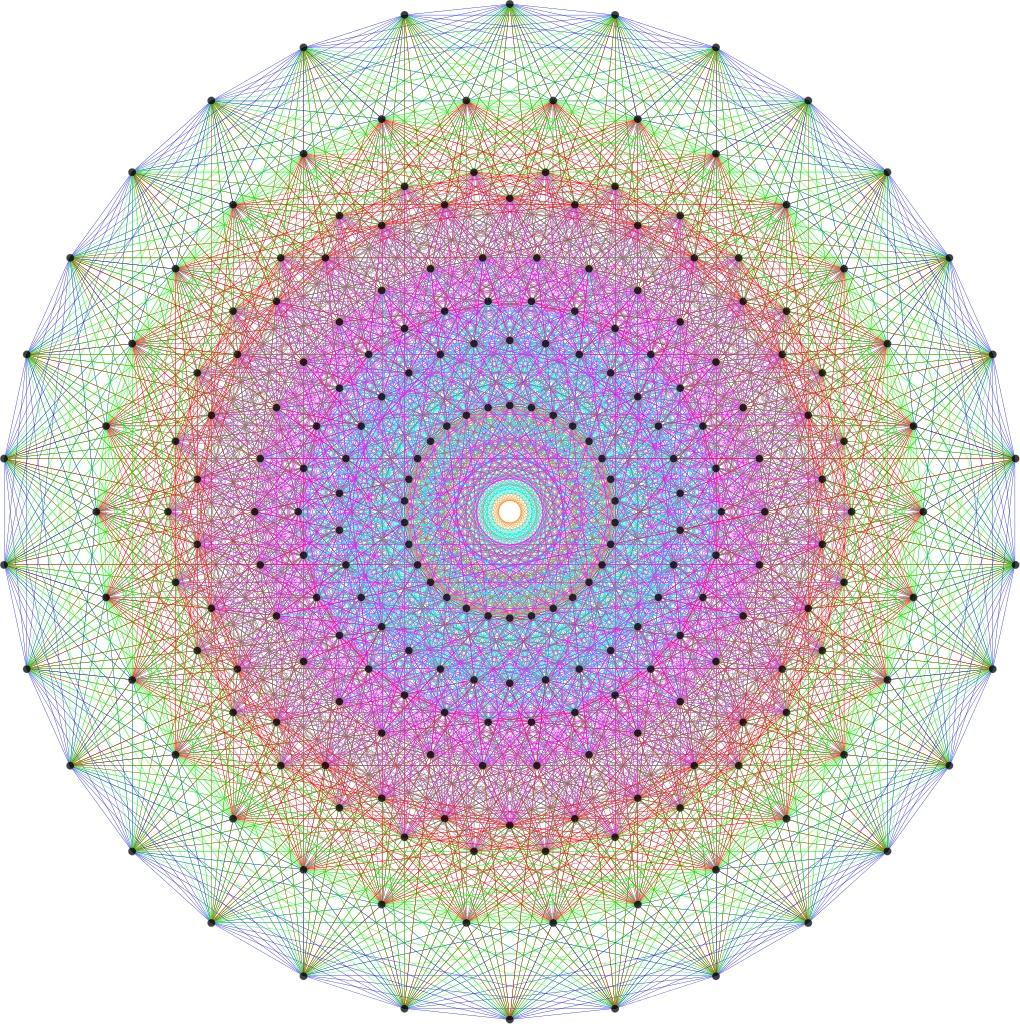
The origin of Lie groups is closely connected to Galois’ group theory. During the Franco-Prussian War in 1870, Lie’s mathematical notes written in German in Paris were mistaken for encrypted messages used by spies, leading to his arrest and detention for a month. Upon release, Lie began studying group theory. He learned that Galois had used group theory 40 years earlier to solve polynomial equations of degree five and higher. Lie sought to apply the same approach to identify symmetries of differential equations and leverage these symmetries to simplify their solutions. However, he found that the methods of group theory only addressed differential equations with discrete symmetries. For differential equations exhibiting continuous symmetries, group theory alone was insufficient. Yet, differential equations with continuous symmetry transformations possess both the structure of a group and that of a manifold. This insight led to the birth of Lie groups. The inherent nature of Lie groups—continuous symmetry—is a fundamental principle in many physical systems (e.g., particle interactions, momentum conservation, energy conservation). This explains why Lie groups play a pivotal role in physics. Moreover, many systems in nature exhibit continuous symmetries (such as gravity and electromagnetic forces), elevating the importance of Lie groups in physics even further. In 1918, Emmy Noether proved that Lie groups underlie some of the most fundamental conservation laws in physics. She demonstrated that for every physical system whose symmetry can be described by a Lie group, there exists a corresponding conservation law.
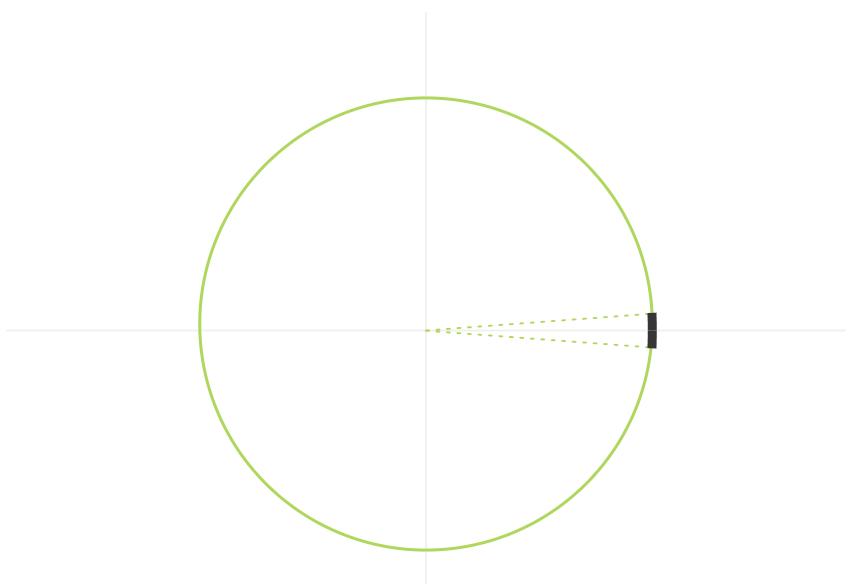
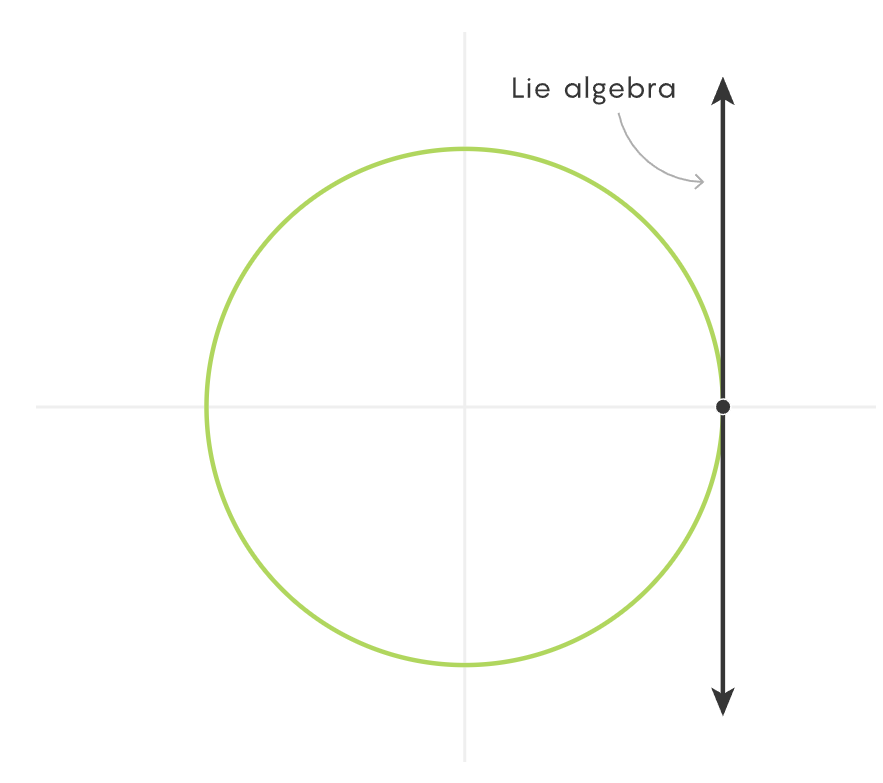
In another article, I encountered an analogy using a flying disc’s rotation (whether rotated by 1.5 degrees, 15 degrees, or 150 degrees, the disc appears the same—unlike a triangle, the disc has infinitely many symmetries). This illustrates the special orthogonal group in two dimensions (these rotations form a group called SO(2)), which is also the simplest nontrivial Lie group. When the rotation angle of the disc approaches zero, every infinitesimal rotation can be represented as a point on the coordinate plane, and at that point, one can draw a tangent line describing the rotation. This tangent line is called the Lie algebra.