The Most Geometrically Intuitive Textbook on Complex Analysis
Visual Complex Analysis, commonly translated into Chinese as 几何化复分析, is a uniquely distinctive complex analysis textbook that provides a fresh perspective on the subject and is acclaimed as the most geometrically intuitive introduction to complex functions.
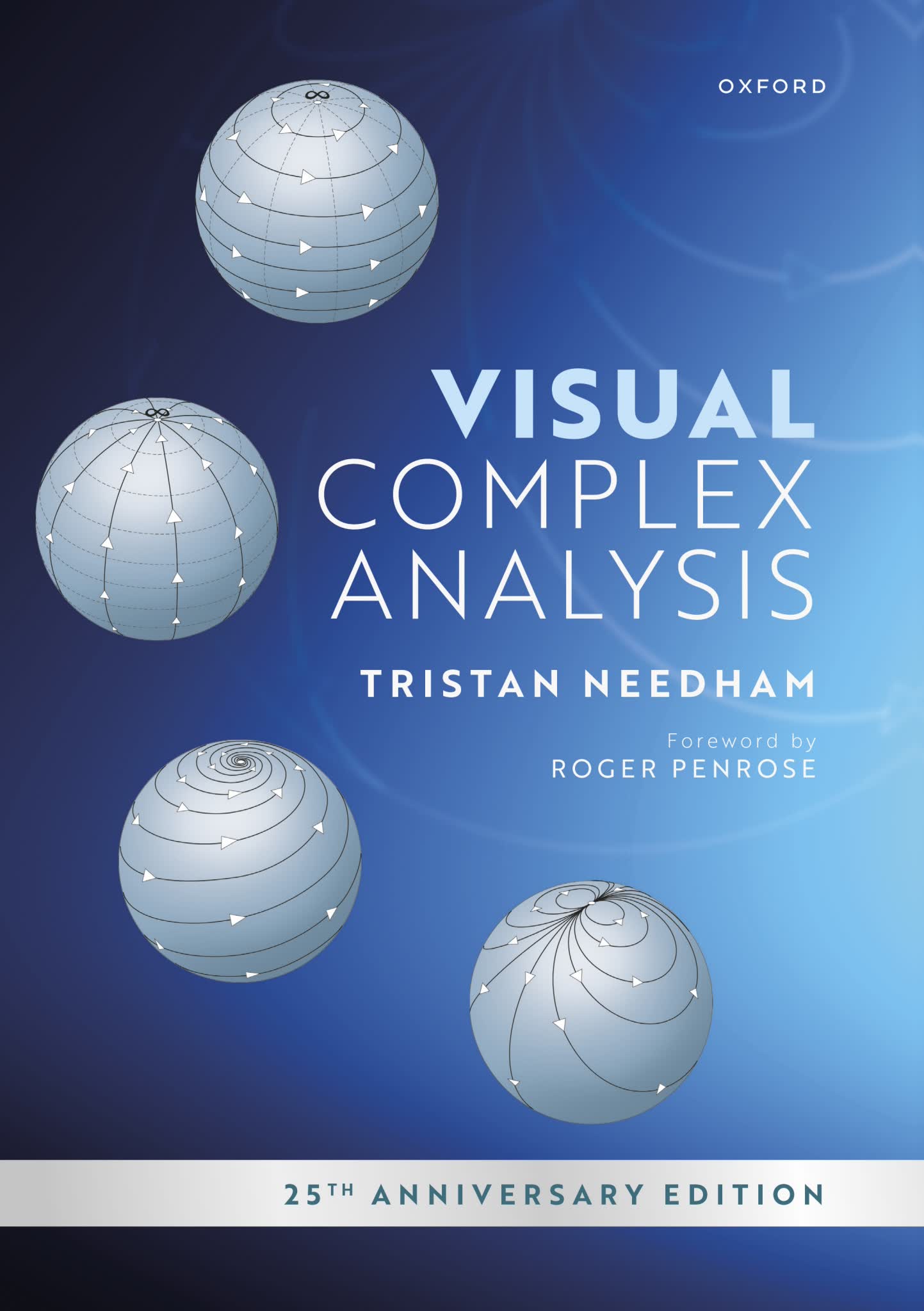
The author of this book is Tristan Needham, who originally studied physics at Merton College, Oxford. Influenced by Roger Penrose (who won the 2020 Nobel Prize in Physics for demonstrating that black holes are a direct consequence of Einstein’s general theory of relativity), Needham transitioned to mathematics and joined the Mathematical Institute at Oxford University. There, he specialized in differential geometry, complex analysis, and related fields, earning a PhD in mathematics. Subsequently, he took a teaching position in mathematics at the University of San Francisco.
The first edition of this book was published in 1997. It explains the theory of complex analysis in a graphical, intuitive manner. The author presents complex analysis with elegant prose and exquisite illustrations that captivate the reader, making them eager to turn the pages. This book breaks away from the abstract and concise thinking style typically ingrained in mathematics students, redirecting their focus toward an innovative yet rigorous approach. Readers come to understand problem-solving intuitively rather than through rote memorization.
This groundbreaking textbook revitalizes this beautiful and powerful discipline by using geometry—not computation—as the primary explanatory tool. It is aimed at undergraduates in mathematics, physics, and engineering, offering intuitive explanations, requiring no advanced prerequisites, and employing a clear, accessible writing style that helps students master the subject faster than ever before. The key lies in replacing traditional computational methods with a new geometric reasoning approach, supported by hundreds of distinctive diagrams rarely seen in mathematical literature. By exploring classical topics from an entirely fresh geometric perspective, this book will undoubtedly attract students and professionals in mathematics, physics, engineering, and related fields.