The Ultimate Guide to Interstellar Travel
The Science of Interstellar is a must-read for anyone who has watched Interstellar. This book serves as a comprehensive scientific annotation of the film, thoroughly explaining all the physical concepts featured. It carefully distinguishes which technologies portrayed in the movie have the potential to be realized and which remain purely imaginative. The book delves deeply into advanced physics topics such as black holes and wormholes. If you’re intrigued by Interstellar, this book is an essential companion—many of the more complex concepts that aren’t fully clear in the film can be clarified here.
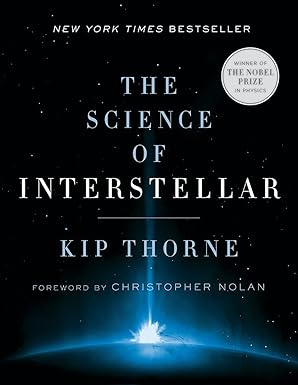
The author, Kip Thorne, won the 2017 Nobel Prize in Physics, primarily for his pivotal theoretical contributions to the discovery of gravitational waves. He has dedicated much of his life to researching Einstein’s theory of general relativity. Thorne is also a physics professor at the California Institute of Technology (Caltech). During the production of Interstellar, he served as the film’s chief scientific advisor, insisting that the director avoid creative liberties that would compromise scientific integrity. Thanks to his involvement, the film’s astonishing events and groundbreaking visual effects are grounded firmly in real science. In the book, Kip Thorne shares his experience as the scientific consultant and delves deeply into the underlying physics. Across chapters on wormholes, black holes, and interstellar travel, Thorne’s scientific insights—many inspired by the film’s scriptwriting and production—illuminate the physical laws governing our universe and the breathtaking phenomena these laws produce.
Additionally, Kip Thorne has served as the official scientific advisor for the TV series The Big Bang Theory. The physics equations written on the show’s blackboards and the scientific discussions among the cast are all vetted and guided by him. It is said that some of the mathematical formulas featured derive directly from Thorne’s actual research.
The book was published almost simultaneously with the release of Interstellar. Director Christopher Nolan even wrote a special foreword for the book. Shortly after its launch, it topped the science bestseller charts. On China’s Douban platform, the book holds an impressive rating of 9.1, while on the international Goodreads platform, it has earned a score of 4.3 out of 5.
Kip Thorne also contributed to the special effects algorithms used in Interstellar. The black hole depicted on screen perfectly reflects the principles of general relativity. In the book, he explains in vivid detail how black holes warp light, surpassing the film’s visuals in clarity and depth. The book also introduces the concept of wormholes, pointing out that future human interstellar travel will most likely rely on wormholes as a means of transportation.
As a child, one might have been amazed by the story in Journey to the West where a day in heaven equals a year on earth—an incredible idea without scientific explanation given by the immortal beings. This book offers a more scientifically grounded explanation: on planets near black holes—which possess immense mass and rapid rotation—strong gravitational fields cause time dilation. For example, on Miller’s planet in Interstellar, one hour is equivalent to seven years on Earth.
The book concludes with behind-the-scenes stories from the making of the film, such as how the visual effects team developed the rendering algorithms and how mathematical formulas were transformed into cinematic images accessible to mainstream audiences.