A Guide to Choosing a Partner Through Popular Math Science Books
A book that teaches readers to view the world through mathematical thinking: The Joy Of X: A Guided Tour of Math, from One to Infinity. This is a purely popular science book, free of complex mathematical formulas, and can be understood without any prior math knowledge.
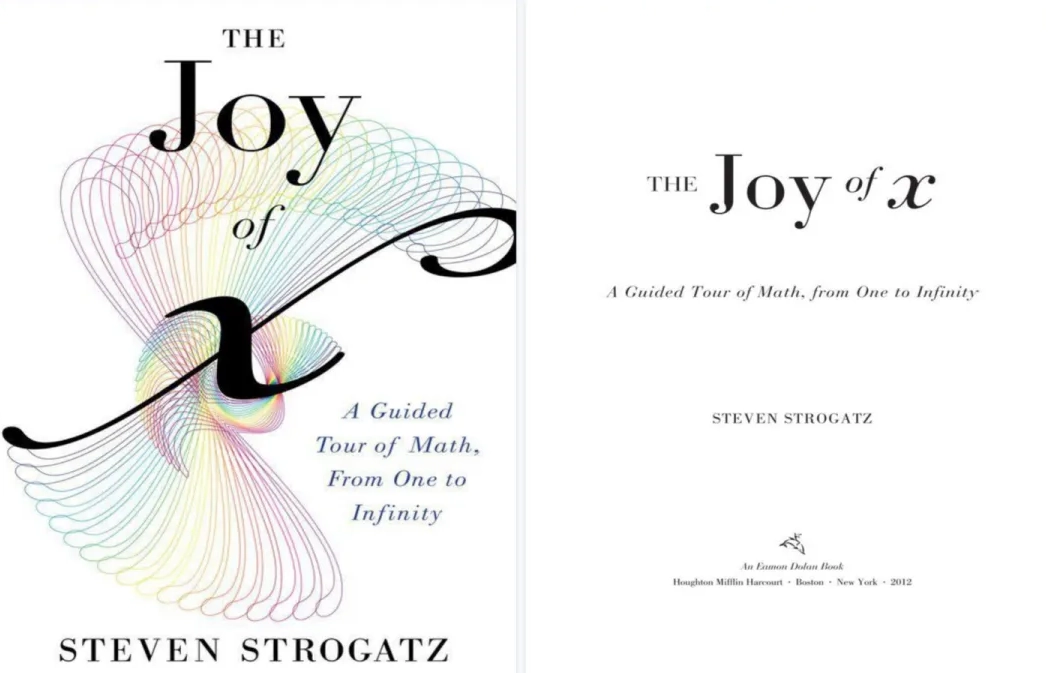
The book takes a unique approach to popular science—not by praising the power of a particular mathematical theorem, but by showing how math affects our daily lives, closely linking mathematics with real-life examples. For instance: “How to maximize the lifespan of a mattress,” “How search engines precisely filter content,” “How many times one should date before deciding to marry,” “Did Simpson really murder his ex-wife,” and “How to expose the lies in Bush’s tax cut plan.” The author uses mathematical models to provide thoughtful reference answers.
Suppose a person encounters n potential partners throughout their lifetime. How can one make the optimal choice (find a truly loving partner)? The author avoids complicated formulas and simply tells you what to do. When facing the major life decision of marriage, neither rush nor wait indefinitely. The author first outlines two extremes:
1. Believing “the first partner is good enough” risks missing someone better.
2. Believing “the right person will always come along” can end in settling for less.
First, consider the total number of partners you might date as n, assuming n = 10:
-
Do not choose any of the first three partners (regardless of how outstanding they are); these three are for establishing your standard and serve as dating benchmarks.
-
Starting with the fourth partner, if this person is better than anyone you’ve dated before, do not hesitate—choose immediately, end dating, and start considering marriage.
Why start making decisions only from the fourth partner? The author explains that when the observation period is about 37% (1/e), the model yields the highest probability of a globally optimal choice. This guideline does not guarantee absolute marital happiness but offers a relatively rational approach to navigating the uncertainty of life. Those feeling confused about love and unsure about decisions might find this method worth trying. However, if you have a clear understanding of marriage and love and have thoroughly planned for the future, this method may not be suitable.
Additionally, it’s crucial to verify the authenticity of information about your potential partner. The dating market is full of “white, rich, beautiful” or “tall, rich, handsome” types who may be deceivers. Here is a simple identification method: if the average score of your initial references is 60, and you meet someone scoring above 90—who seems flawless—this person is likely a fraud.
The author, Steven Strogatz, graduated from Princeton with a degree in Mathematics, earned his PhD in Applied Mathematics from Harvard, and is currently a professor of Applied Mathematics at Cornell University. He is an expert in complex systems and nonlinear dynamics, known for simplifying complex mathematical concepts into easy-to-understand language. Unlike experts who merely showcase formulas, Strogatz genuinely hopes readers will enjoy math. He has authored many classic works, including the more advanced popular science book Sync: How Order Emerges from Chaos, the calculus-focused popular science book Infinite Powers, and the textbook Nonlinear Dynamics and Chaos in his field.
Many who know the author describe him as someone who is both a frontier researcher and a friendly teacher willing to explain that 1 + 1 = 2. He can convey complex mathematical concepts in plain language, making him a revered figure in the mathematics community—akin to a humble master monk. The author often says, “If you find math difficult, it’s not your fault.”