What Is the Essence of Learning Ability
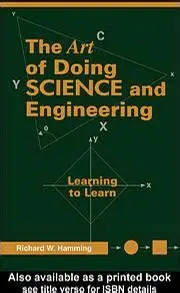
Learning ability is not simply about quick memorization, fast learning, or good exam scores. In The Art of Doing Science and Engineering: Learning to Learn, author Hamming reveals the true nature of learning.
-
Learning ability is not just rote memorization. It’s not about mastering the cubic formula today and the quartic formula tomorrow. Learning ability means restructuring your cognitive framework so that when you learn there is no radical solution for the quintic equation, you comprehend that having radical solutions for equations of lower degrees is purely coincidental.
-
Learning ability is mainly demonstrated by applying familiar methods to new problems. For example, mathematical techniques are frequently applied in engineering practice (calculus in signal processing systems, linear algebra in computer graphics, number theory in cryptography).
-
Decision-making ability is a part of learning ability. Some say making the right choices is more important than hard work, but in fact, decision-making itself is a component of learning ability. To achieve success in any field, making the “right” choice at the outset is less critical than having the capacity for continuous course correction. These abilities form a positive feedback loop for sustained learning.
-
Embrace mistakes. It is crucial to confront and acknowledge the errors encountered during learning. Many learners refer to these as “pitfalls,” but these pitfalls are essential on the learning path—the deeper the pit, the more solid the learning.
-
Learning is a long-term process. It doesn’t end with graduating from high school or entering university; learning is a marathon. As an old saying goes, “Live and learn.”
If one sentence were to summarize learning ability, it would be: “Learn to change the way you view the world.” This is why some people say, “Some die at 30, while others only get buried at 70.”
The author of this book, Hamming, was originally a scientist at Bell Labs, with outstanding contributions to computational communications. In this book, he uses scientific thinking to systematically discuss how to cultivate the ability to learn.