Mathematician Terence Tao’s Personal Website
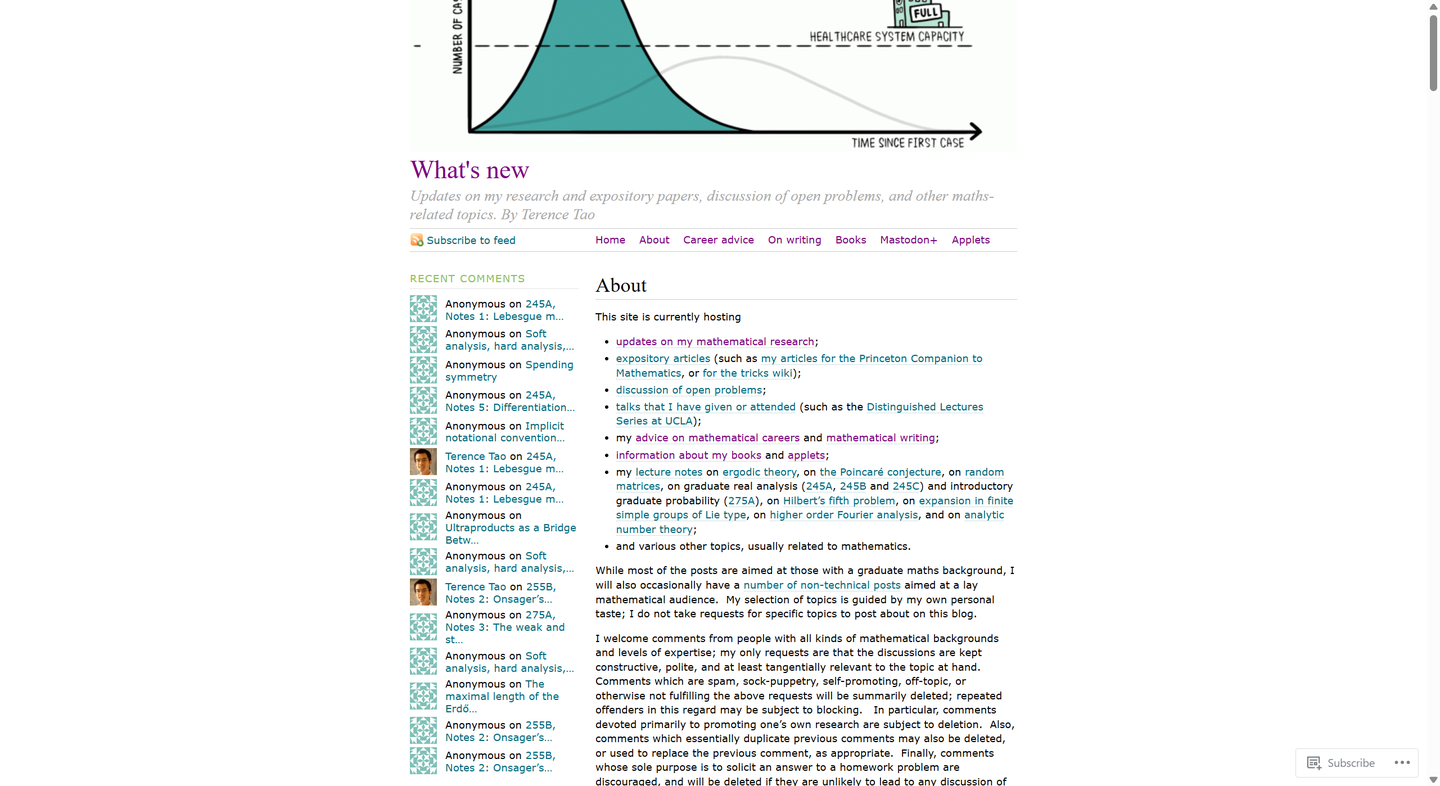
This pure mathematics blog is built on WordPress and was launched in 2007, now approaching 20 years of history. The website mainly records Terence Tao’s mathematical research progress, lectures, teaching materials, books, and other content. Much of this material requires a strong mathematical background to fully grasp—for example, articles related to harmonic analysis, partial differential equations, and number theory. However, it also includes very detailed educational advice oriented towards the general public, providing mathematics learning recommendations from elementary school all the way through postdoctoral training.
Elementary School Stage:
Maintain the child’s enthusiasm for learning and praise their progress. Avoid putting too much pressure on children at this age, and do not take them to IQ tests, since higher IQ does not necessarily correlate with greater academic achievement.
Middle School Stage:
For gifted students, participating in various academic competitions is recommended. Additionally, Tao offers advice on selecting universities: don’t place excessive emphasis on the university’s prestige alone, as every university has its own strengths and weaknesses. Consider all factors comprehensively before making a decision. Furthermore, don’t choose a major simply because you heard it pays well—for instance, a few years ago, many students blindly chose civil engineering when real estate was booming; later computer science became popular and many switched to that. Chasing trends is meaningless; sometimes you have to ask yourself what you’re truly interested in. Tao himself attended Flinders University for his undergraduate studies, which he describes as being close to home with a good learning atmosphere.
Undergraduate Stage:
The goal of mathematics is not to achieve the highest rankings, highest scores, or the most awards; rather, it is to deepen understanding of mathematics (whether for yourself, your colleagues, or your students) and to contribute to the development and application of mathematics.
Graduate Stage:
- Hard work and professionalism are important, but enjoying your work is equally essential.
- Planning ahead helps you understand the direction forward; asking seemingly naïve questions helps you understand the path you have taken.
- Attend lectures and conferences, even those not directly related to your own research.
- Talk with your advisor but also take initiative.
- Avoid becoming prematurely fixated on a “big problem” or “grand theory.”
- Write down your work and publish your results. On this, I have some advice about how to write and submit papers.
Postdoctoral Stage:
- Study and continually revisit your specialty, but don’t be afraid to learn beyond it.
- Understand the limitations of the tools you currently use and learn about the strengths of other mathematicians’ tools. Crucially, you should constantly set goals beyond your current level of ability.
- Be flexible and patient in your research process.
- If possible, seize opportunities to give talks and showcase your research. But be mindful of your audience; speaking and writing papers are different.
- Maintain a healthy skepticism about your own work and don’t be afraid to discard drafts.
Reading Terence Tao’s articles reveals the profound thinking of a master mathematician. Even when some articles are difficult to understand, it becomes clear that this is not showmanship, but a mature and restrained way of documenting the extension of thought.
Website: terrytao.wordpress.com