The Best Books for Learning Mathematical Analysis
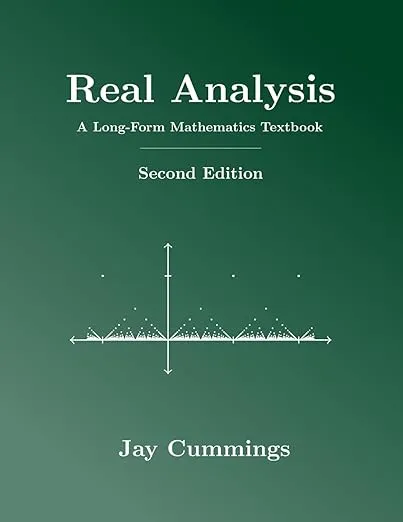
I recommend Real Analysis: A Long-Form Mathematics Textbook.
This is a mathematics analysis textbook specifically written for instructional use. Like the others in its genre, it does not follow the traditional “definition > proof > example” rigid format. Instead, it presents the background, motivation, reasoning (even including calculation drafts), and detailed examples related to the theorems to help readers understand why the proofs are constructed in such a manner. The book also features rich illustrations, making it ideal for both classroom teaching and self-study.
Let me first introduce the A Long-Form Mathematics Textbook series, translated as “Long-Form Mathematics Textbooks” in Chinese. This series consists of three volumes, all authored by Jay Cummings. Among them, Proofs: A Long-Form Mathematics Textbook focuses primarily on how to write clear and precise mathematical proofs. Another volume, Math History: A Long-Form Mathematics, is dedicated to the history of mathematics. Due to the series’ great popularity, the author has also launched a dedicated website, Long(er)-Form Mathematics, and sells related merchandise such as t-shirts, mugs, stickers, and more.


In the images, two ancient Chinese mathematicians appear. Searching by pinyin, they seem to be Liu Hui from the Wei-Jin period and Yang Hui from the Southern Song dynasty.
Compared to traditional real analysis textbooks, this book is considerably longer. Readers with a strong mathematical background might even find it somewhat verbose. However, in order to clearly elaborate on the proof processes and to make mathematical analysis accessible to a broader audience (including those with limited foundational knowledge), the author deliberately adopts a slower pace, extending the exposition and revealing many of the thought processes that typical textbooks tend to omit. This approach lowers the barrier to entry for learning mathematical analysis.