The Best Self-Study Book for Advancing in Probability Theory
A highly recommended self-study reference for probability theory is Probability Theory: The Logic of Science (abbreviated as PTLOS). Due to its broad scope and depth, it thoroughly demonstrates how Bayesian statistical methods replace, rather than compete with, “orthodox” (sampling-theory-based) statistical methods. With a focus on exposition rather than extensive formulas, it is rarely used as a textbook but is ideal for readers who have already mastered the basics of probability theory and wish to deepen their understanding.
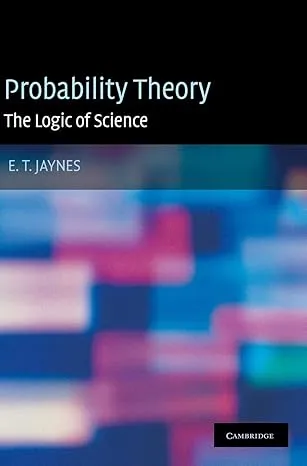
The book’s main content was completed by E. T. Jaynes and compiled into a book by his student G. Larry Bretthorst in 2003. Jaynes was a leading figure in objective Bayesianism, holding a PhD from Princeton and serving at the University of Washington. Throughout his career, he dedicated himself to mathematizing rational inference and formalizing probability theory logically. He argued that probability is not a frequency statistic of random phenomena but rather a measure of the credibility of uncertain propositions. The book offers a detailed explanation of why the rules of probability are as they are.
This book is not suitable for beginners—it requires a solid foundation in probability theory and calculus, and ideally some familiarity with philosophy. It is often recommended by university probability instructors as a reference for their students.
Some students complain that the book leans too much toward philosophy. In fact, it grounds probability theory on a firm scientific-philosophical foundation. For example, traditional probability textbooks teach you how to compute mathematical expectations, variance, and laws of large numbers, whereas Jaynes emphasizes that formulating noninformative priors stems mainly from logic and symmetry principles. The book transcends the traditional mathematical framework of probability by placing probability theory within a broader conceptual context. It not only covers new research findings but also explores the applications of probability in various problems. Containing numerous exercises, it is suitable as a graduate-level data analysis course textbook. The book is aimed at readers with a strong undergraduate or higher-level background in applied mathematics and is a valuable reference for researchers working on inference with incomplete information.
Some critics say the book lacks rigor, likely due to the substantial philosophical content. However, historically, mathematics and philosophy have been inseparable fields that complement each other.