Probability Theory: Written for the Passionate Beginner
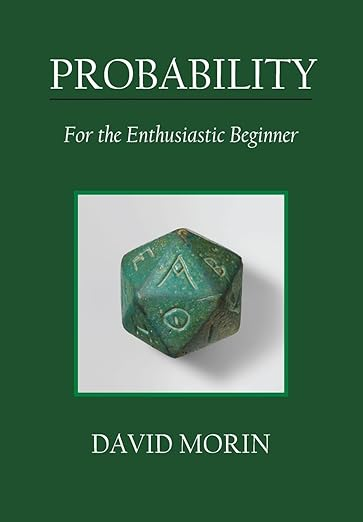
Recommended: Probability: For the Enthusiastic Beginner, a direct translation of the Chinese title 《概率论:写给充满热情的初学者》. This book comprehensively covers all the standard foundational topics in probability theory, including combinatorics, probability rules, Bayes’ theorem, expectation, variance, probability density, common distributions, the law of large numbers, the central limit theorem, correlation, and regression analysis. It also contains 150 thoroughly solved problems, some involving calculus. Ranked #1 in sales among probability theory books on Amazon, it enjoys an excellent reputation among students and is particularly well-suited for self-study.
The author, David J. Morin, is a physics lecturer at Harvard University and has authored several university textbooks. This book is designed as an introductory probability textbook for engineering students. Compared to those aimed at mathematics majors, it is less rigorous and less focused on formal proofs. However, for engineering students, it is more than sufficient. Its rich collection of example problems makes it ideal preparation material for exams in engineering programs.
Main Topics Covered:
-
Combinatorics: Explains how to calculate various combinations, including those with and without repetition, as well as ordered and unordered sets.
-
Fundamental Probability Concepts: Definitions of probability, determinations of “AND” and “OR” combinations, Bayes’ theorem, Stirling’s formula, expectation, variance, and standard deviation.
-
Probability Distributions: Uniform, Bernoulli, binomial, exponential, Poisson, and Gaussian distributions.
-
Limit Theorems: Gaussian approximation, law of large numbers, central limit theorem.
-
Correlation and Regression: Definitions of correlation, correlation coefficients, and regression lines.
-
Additional Details: Covers special topics such as Euler’s number, approximations, key results, and a glossary of terms.
Unlike traditional mathematics textbooks that follow a “definition–theorem–proof” format, this book presents concepts through a variety of problems and narratives. This approach encourages readers to organically develop an intuitive, trend-based understanding of probability theory. Perhaps this is why the book has garnered such high praise from numerous students.