What Is the Relationship Between Mathematics and Physics?
Mathematics and physics are inseparable. The essence of physics, particularly theoretical physics, is fundamentally the study of mathematical structures that describe phenomena. For example, without Riemannian geometry, there would be no general relativity. Mathematics always holds a key position in groundbreaking discoveries in physics.
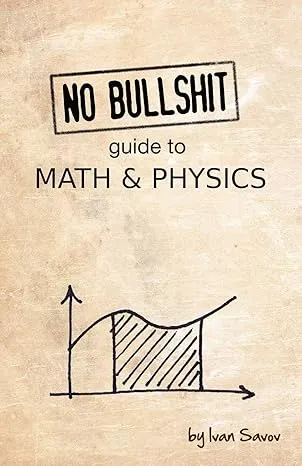
There is a book titled No Bullshit Guide to Math and Physics, which specifically combines mathematics with classical physics. It provides a detailed explanation of the relationship between mathematics and classical mechanics, making it an excellent choice for readers interested in understanding the connection between mathematics and foundational physics. Although the content is quite basic, it allows readers to grasp the close relationship between mathematics and physics, eliminating any doubts about which discipline is more important.
Physics textbooks typically present laws directly and then provide an equation, but rarely delve into the mathematical derivations behind them. For example, when learning Archimedes’ principle of buoyancy, one first encounters a descriptive statement: “The buoyant force on an object submerged in a fluid equals the weight of the fluid displaced by the object.” This is followed by a formula, such as F = V, which students generally only need to memorize. But how is this formula actually derived? Science cannot always be done the way Mendeleev did, who famously dreamt up the periodic table. This book offers a thorough explanation of the mathematical derivations behind classical physical laws, helping readers understand not only the physical phenomena but also the mathematical principles underlying those laws. While Archimedes did not use modern integral calculus, he employed the then-popular method of exhaustion, dividing volumes into infinitely small parts and summing them to rigorously derive the buoyancy formula.
The author of this book, Ivan Savov, has many years of experience teaching mathematics and physics. He firmly believes that understanding the principles behind formulas is more important than memorizing the formulas themselves. To this end, he founded a publishing company dedicated to producing the No Bullshit Guide series.