Mathematics: From the Birth of Numbers
Mathematics: From the Birth of Numbers is a popular science book on mathematics, translated into Chinese as 《数学:从数字的诞生开始》.
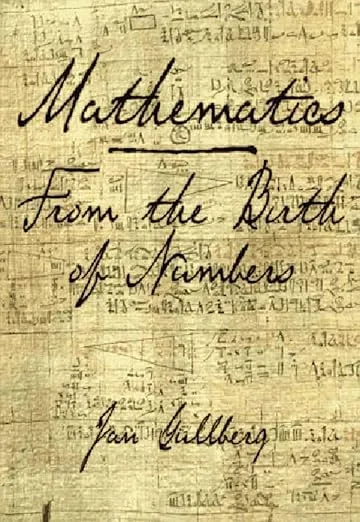
The author, Jan Gullberg, is a surgeon who wrote this book in his spare time, which explains why it took a cumulative 10 years to complete. The first edition was published in 1997. This substantial volume spans over 1,000 pages, covering an extensive range of topics. It begins with the origins of numbers, exploring how they came into existence, followed by counting systems of ancient Rome and Babylon. The narrative gradually progresses through mathematical axioms, proofs, set theory, algebra and equations, geometry and trigonometry, ultimately reaching calculus, vectors, matrices, probability, fractals, and more. Essentially, it encompasses nearly all foundational mathematics from middle school to university level.
Beyond foundational mathematical concepts, the book intersperses engaging historical anecdotes related to mathematics, and even presents some meaningful mathematical problems. When discussing why humans needed numbers, it introduces counting symbols and numeric bases from various civilizations worldwide, illustrating methods such as the Egyptian doubling technique and the Russian peasant multiplication.
The scope of the book is broad, starting from the dual invention of numbers and language, traversing through the main fields of arithmetic, algebra, geometry, trigonometry, and calculus, finally arriving at differential equations. Along the way, it also explores mathematical logic, set theory, topology, fractals, probability theory, and various other branches of mathematics. Standing out among numerous popular mathematics books, it skillfully combines an engaging and accessible history of mathematics with a comprehensive mathematical overview. As the author states, the book aims to “benefit those who have never studied mathematics, those who believe they have forgotten what they learned, and those who sincerely desire to learn more.” It connects mathematics with the humanities, linguistics, natural sciences, and technology.
Featuring over 1,000 original technical illustrations, many drawn from classic mathematics texts and other related works, the book also includes a wealth of humorous asides, ranging from limericks and curious anecdotes to cartoons and decorative artwork. Suitable as a supplementary resource for high school and university freshmen, it can also serve as a practical handbook for engineers.