A Novel About Math Sweethearts
There is a novel focused primarily on mathematical knowledge called Math Girls, which is commonly translated into Chinese as 《数学女孩》. This novel delves into relatively deep and fascinating mathematical concepts. It features three main characters (one male and two females), all high school students. The story is not about cliché romantic entanglements but revolves around daily school life and discussions about math. While there is a subtle emotional undertone, the relationships between the protagonists are portrayed with a light touch—never overly sentimental or contrived—capturing the essence of adolescence where academics dominate and feelings remain tenderly vague.
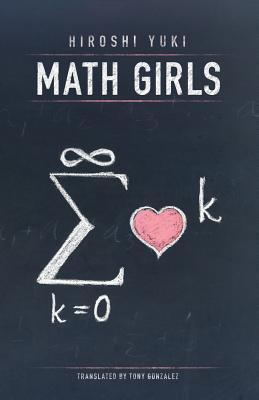
What makes the novel particularly interesting is that the mathematics covered ranges from high school to university level, including sequences, recursion, basic algebra, infinity, infinite series, harmonic numbers, Taylor expansions, the Basel problem, and more. Reading this novel is akin to casually learning a variety of mathematical concepts along the way. In some ways, it even sparks the reader’s interest in math. For example, one day the male protagonist encounters a sequence problem (1 + x + x² + x³ + … = ?) and asks one of the female protagonists, Miruka, how to solve it. Instead of directly giving the answer, Miruka asks him what happens when you multiply this series by (1 - x). After a while, the male protagonist calculates the result and finds it equals 1, thereby deducing that the sum of the original series is 1/(1 - x)—a classic example of a geometric series. This problem also showcases Miruka’s superior mathematical skills compared to the male protagonist.
There is another even more meaningful discussion where the other protagonist, Tetra, asks the male lead a simple equation: why does 3² + 4² = 5²? The male protagonist first rewrites the equation as a² + b² = c² and then gradually demonstrates that this is a way to generate Pythagorean triples (of which there are infinitely many integer solutions). When the exponent is raised to 3 or higher, the equation becomes Fermat’s Last Theorem (which has no integer solutions).
The novel’s conclusion is quite romantic but avoids any vulgar clichés about who ends up with whom. Miruka suddenly leaves, and the male protagonist experiences a mysterious sadness over her departure. Mathematics brought them together, but ultimately, everyone must follow their own path.
There is also a sequel, Math Girls 2 - Fermat’s Last Theorem, where Miruka returns. It is said the sequel covers even deeper mathematical topics but still contains no romantic storyline. Perhaps in our own growth, we all need to learn solitude and to coexist peacefully with ourselves.
What is truly surprising is that there is a third installment, Math Girls 3: Gödel’s Incompleteness Theorems. The mathematics here is even more abstract, yet the core remains math-centric with campus life interwoven. Miruka remains cool and aloof, Tetra progresses rapidly, and the male protagonist grows in various ways. Again, no sweet love stories, but precisely for this reason, the novel has won the admiration of countless readers.
To be fully transparent, the series actually includes six volumes, each increasingly challenging mathematically: Math Girls 4: Random Algorithms, Math Girls 5: Galois Theory, and Math Girls 6: The Poincaré Conjecture. PDFs of the first three volumes are available electronically, but the latter three have yet to be found.