The Best Introductory Books on Probability Theory
Introduction to Probability Models, known in Chinese as 概率模型导论, is one of the best books for learning how probability can be used to model real-world systems. Unlike many other probability texts, this book covers multiple disciplines. It provides a thorough explanation of probability and stochastic processes, with an in-depth exploration of their applications across a wide range of fields. The author includes numerous exercises and clear examples in each chapter. He also carefully explains the intuition and reasoning behind many theorems and proofs. Even readers outside the field will find this book a rewarding read.
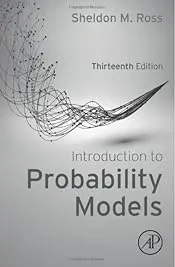
The author, Sheldon M. Ross, holds a Ph.D. in statistics from Stanford University. After graduation, he taught for many years at the University of California. His primary research areas include applied probability, stochastic processes, queueing theory, statistical analysis, financial mathematics, and risk modeling. He has written many probability textbooks that balance theory with practical applications, widely adopted by universities around the world. This book is also well-suited for students in engineering, finance, and data science who wish to study independently.
The first edition of this book was published in 1972. Due to ongoing advancements in the relevant theories and high demand among users, the author has updated it multiple times. The latest edition, the 13th, was released in 2023.
Main contents of the book:
-
Probability Fundamentals: Random events, conditional probability, Bayes’ theorem, discrete variables, continuous variables, etc.
-
Probability Distributions: Binomial, Poisson, exponential, gamma, normal, conditional distributions, marginal distributions, etc.
-
Markov Chains: Recurrence equations, stationary distributions, long-term behavior, etc.
-
Poisson Processes: Definitions and basic properties, nonhomogeneous Poisson processes, etc.
-
Continuous-Time Markov Chains: Rate matrices, Kolmogorov equations, etc.
-
Renewal Theory: Renewal processes, delayed renewal, etc.
-
Queueing Theory: Little’s law, queueing networks, etc.
-
Reliability Models: Series systems, parallel systems, replacement policies, reliability, etc.
-
Brownian Motion: Wiener process, increments, specific applications, etc.
-
Monte Carlo Simulation: Random number generation, system simulation, convergence, etc.