What Exactly Is "Graph Theory" in Mathematics?
On the surface, graph theory studies “vertices and edges,” but essentially, it investigates discrete relationships, exploring how “local changes” affect the “overall structure.” When a certain number of objects form a whole according to specific rules, what properties does this whole exhibit?
For example, the famous “Six Degrees of Separation” theory states that any two strangers in the world can be connected through no more than six intermediaries. This theory originated from a small experiment conducted by Stanley Milgram, a psychology professor at Harvard, which involved sending a paper letter to a complete stranger (the letter contained the stranger’s name). The rule was that you could only pass the letter to someone you knew personally. After conducting many trials, Milgram found that the average number of handoffs before the letter reached its intended recipient was fewer than six.
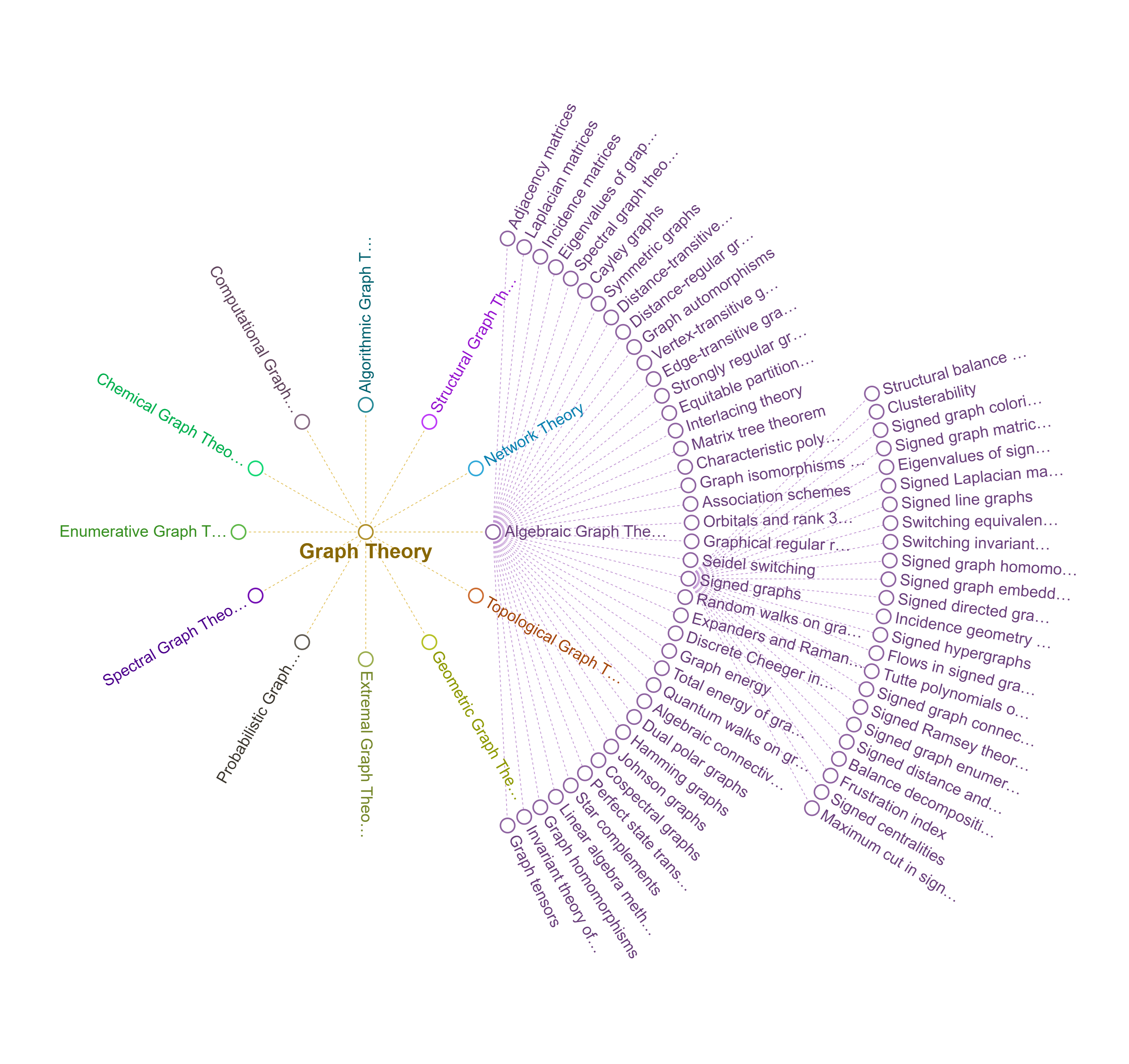
Fundamentally, the Six Degrees of Separation theory treats every person in the world as a vertex, and an edge exists between two people who know each other. The number of steps required to successfully deliver the letter between two strangers is essentially a shortest path problem in graph theory. Graph theory deals with such problems (for instance, if there is a shortest path, there must also be a longest path). A recommended introductory book on graph theory is Introduction to Graph Theory by Richard J. Trudeau, which thoroughly explores the essence of graph theory. Although graph theory studies vertices and edges, it is not concerned with their quantity but rather with the relationships between vertices and edges.
In mathematics, graphs are a core object of study in discrete mathematics. In many branches of mathematics—such as combinatorics, probability, and topology—graphs are used as tools. In applied fields, graphs also play a crucial role. For example, weighted directed graphs in neural networks, network topology graphs on the internet, and weighted graphs in urban transportation networks all use graphs to provide abstract models for studying complex systems.