A Practical Guide to Mastering Algorithms: Concrete Mathematics
“Concrete Mathematics: A Foundation for Computer Science,” commonly translated into Chinese as 《具体数学》, is a transitional book bridging continuous and discrete mathematics. Unlike purely theoretical math books, this text focuses on applied algorithm analysis and programming examples, such as recurrence relations and discrete probability models, making it highly suitable for computer science students.
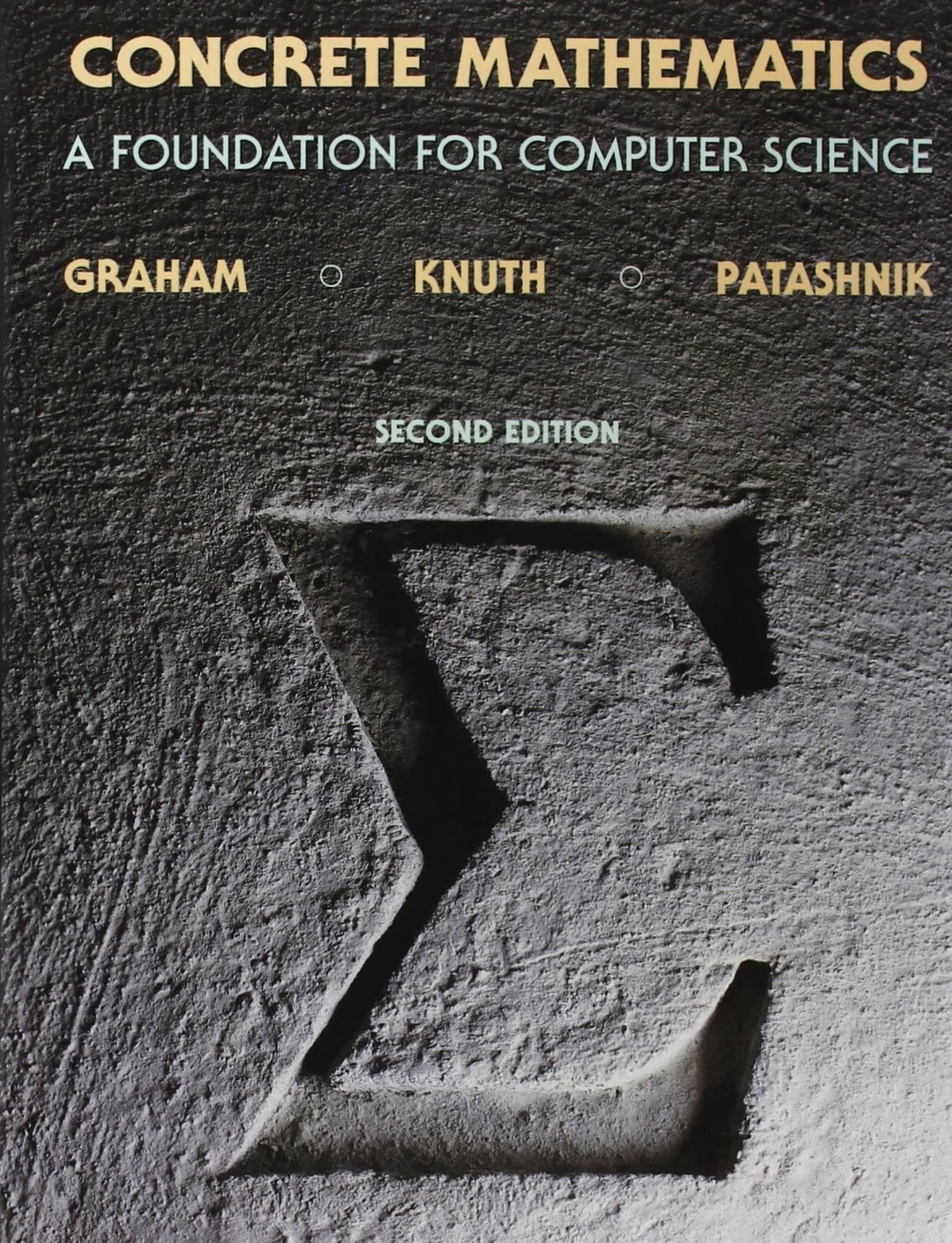
The book has three authors: Ronald L. Graham, an expert in combinatorics, who contributed chapters on binomial coefficients and discrete probability; Donald E. Knuth, a foundational figure in computer science, a professor at Stanford University, ACM Turing Award winner, and the lead author responsible for sections on summations and recurrences; and Oren Patashnik, a computer scientist responsible for the parts on generating functions and exercises.
Many universities use this book as a preparatory text for algorithm analysis courses in computer science. It presents the mathematical foundations of advanced computer programming and algorithm analysis. While many students can write algorithms to solve problems in practice, they often lack a clear understanding of complexity analysis. This book teaches little about algorithms themselves but focuses primarily on how to use mathematics to analyze algorithms thoroughly. As such, it also serves as a valuable reference when one needs clarity on a particular algorithm.
Together with CLRS (Introduction to Algorithms) and TAOCP (The Art of Computer Programming), this book is considered one of the “Three Musketeers” of algorithm theory. For anyone seeking to improve their algorithmic skills, these three volumes are indispensable. Among them, this book is of intermediate difficulty: CLRS serves as an introductory guide, this book teaches you the real skills, and TAOCP helps you take off to new heights. It is best to study these books in order of increasing difficulty; otherwise, the learning curve will be very steep. Additionally, this book includes over 500 exercises, requiring significant time and effort to master.
Notably, TAOCP’s author is one of this book’s authors, Donald E. Knuth. Reading this book requires a solid mathematical foundation, with some familiarity with calculus, linear algebra, and discrete mathematics. The text includes advanced formula derivations from a master’s perspective, which can be difficult to follow without adequate background.
The book originally grew out of courses Donald E. Knuth taught at Stanford University as an extension of TAOCP, prompted by student feedback that TAOCP alone was too challenging and that an intermediate resource was needed. This book was born to fill that gap. These two works are part of the reason Donald E. Knuth was awarded the ACM Turing Award. Moreover, the famous typesetting system TeX was also developed by Knuth, a tool well known to anyone involved in academic paper and book typesetting.
This book also popularized several mathematical notations, including the Iverson bracket, floor and ceiling functions, as well as rising and falling factorial symbols.
Although published over 30 years ago, the content remains highly relevant. It can even be confidently stated that, unless quantum computers become widespread, this book will remain applicable for computer science education indefinitely.
The authors encourage readers to report any minor errors found in the book. A reward of $2.56 will be given for each verified error discovered.