The Simplest Introductory Book on Calculus
I recommend a book that may be the simplest introduction to calculus: Calculus Made Easy. Even middle school students with a good grasp of basic algebra and an interest in math can use this book to start learning calculus ahead of time. This book was written by British physicist Silvanus Phillips Thompson in 1910, over 100 years ago. The author’s goal was to make calculus accessible and easy to understand.
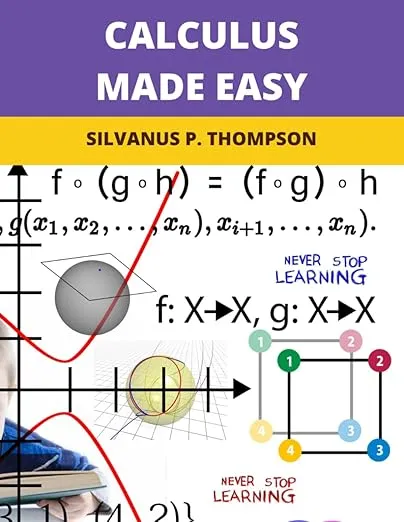
Unlike other formula-heavy calculus textbooks, this book adopts a conversational tone, first explaining calculus concepts in intuitive language before gradually introducing specific arithmetic rules of calculus. It is recommended to read through it once; if some parts are unclear, feel free to skip over them and revisit the difficult sections more slowly.
This book is perfect for beginners with no prior knowledge of calculus. After reading it, those cryptic calculus formulas won’t feel daunting anymore. It lifts the veil of mystery surrounding calculus and transforms this typically intimidating subject into an enjoyable and approachable learning journey for math learners of all levels.
The author avoids overwhelming readers with complex formulas. Instead, through clear, intuitive explanations and practical, real-life applications, the book lays a solid foundation and reveals the wonders of calculus.
Calculus Made Easy is more than just a textbook; it contains not only theoretical explanations but also exercises with answers, ensuring readers can solve problems as well as understand the underlying principles.
This book encourages self-study, making each page a step forward on your path to mastering calculus.
Main topics covered:
- Overcoming the fear of starting calculus
- Different degrees of smallness
- Relative growth
- The simplest cases
- The next step: how to handle constants
- Sums, differences, products, and quotients
- Successive differentiation
- Rates of change with respect to time
- Useful tricks
- The geometric meaning of differentiation
- Maximums and minimums
- Curvature of curves
- Additional useful techniques
- The true nature of compound interest and organic growth laws
- How to handle sine and cosine
- Partial differentiation
- Integration
- Integration as the inverse operation of differentiation
- Finding areas through integration
- Tips, pitfalls, and how to succeed