Calculus: An Intuitive and Physical Approach
How do we determine the instantaneous velocity of an object whose speed is constantly changing at a specific point in time?
First, isn’t the object actually stationary at any given instant? Indeed, at a fixed moment, the displacement is zero, so it’s not incorrect to say the object is momentarily at rest. So how can an object have an instantaneous velocity at a certain point in time? In fact, this is where calculus comes into play. By considering an extremely short increment of time (for example, 1 millisecond) immediately following that instant, the velocity during this tiny interval is nearly constant. Therefore, finding the instantaneous velocity is essentially finding the average velocity over an infinitesimally small time interval—one that approaches zero—which is the mathematical concept of a limit.
In fact, this is partly a translation challenge. The term “瞬时速度” (instantaneous velocity) is often misunderstood as the velocity at a fixed point in time. The original English term, instantaneous velocity, is somewhat easier to grasp. The book Calculus: An Intuitive and Physical Approach takes a physics-oriented perspective, thoroughly exploring calculus concepts such as derivatives, differentials, and integrals, while also introducing topics like trigonometric functions and polar coordinates.
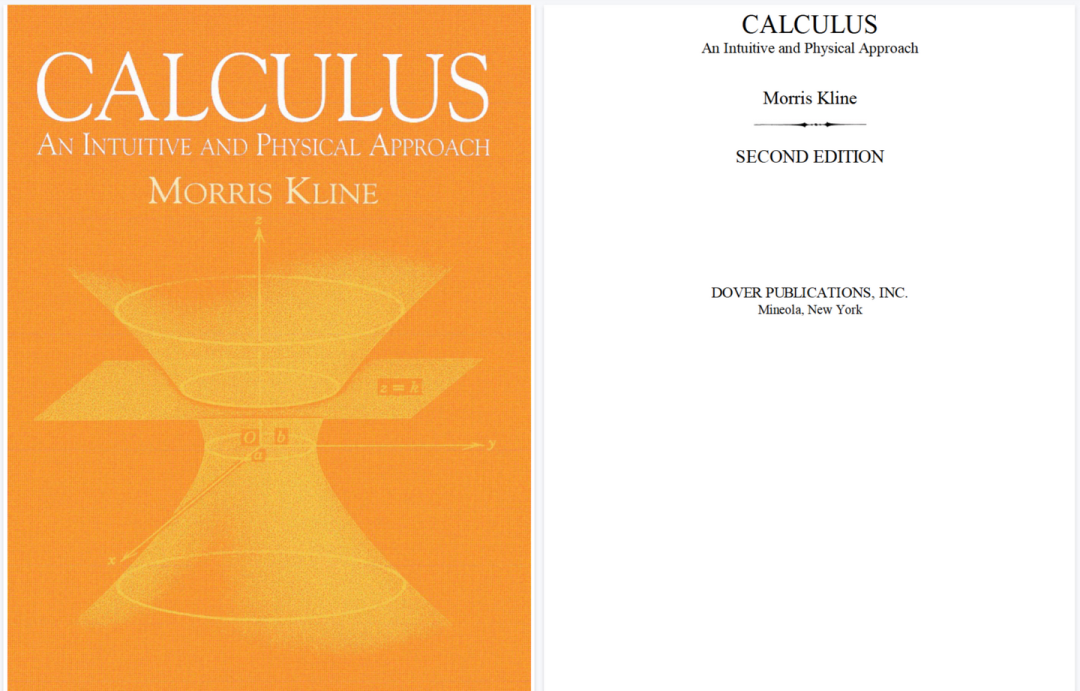
The Chinese title of the book, 微积分:一种直观且物理化的方法 (“Calculus: An Intuitive and Physical Approach”), is ideal for those seeking to understand calculus through the lens of physics. Many physical concepts become straightforward when interpreted through calculus, removing the need for memorizing formulas or relying on rote problem-solving strategies. In fact, Newton’s development of calculus originally stemmed from considerations of motion. However, since Leibniz published calculus earlier, most introductory textbooks follow Leibniz’s more abstract, symbol-heavy framework. This often makes learning calculus challenging for students who struggle with abstract thinking.
The author, Morris Kline, holds a PhD in pure mathematics from New York University, specializing in analysis and the connections between mathematics and physics. This book weaves calculus together with physics, offering a fresh approach to learning both calculus and foundational physics.