The Best Introductory Book for Learning Calculus
Calculus by James Stewart is a highly recognized introductory textbook used at universities around the world. The author, James Stewart, is a Canadian mathematician who holds a Ph.D. in Mathematics from Stanford University.
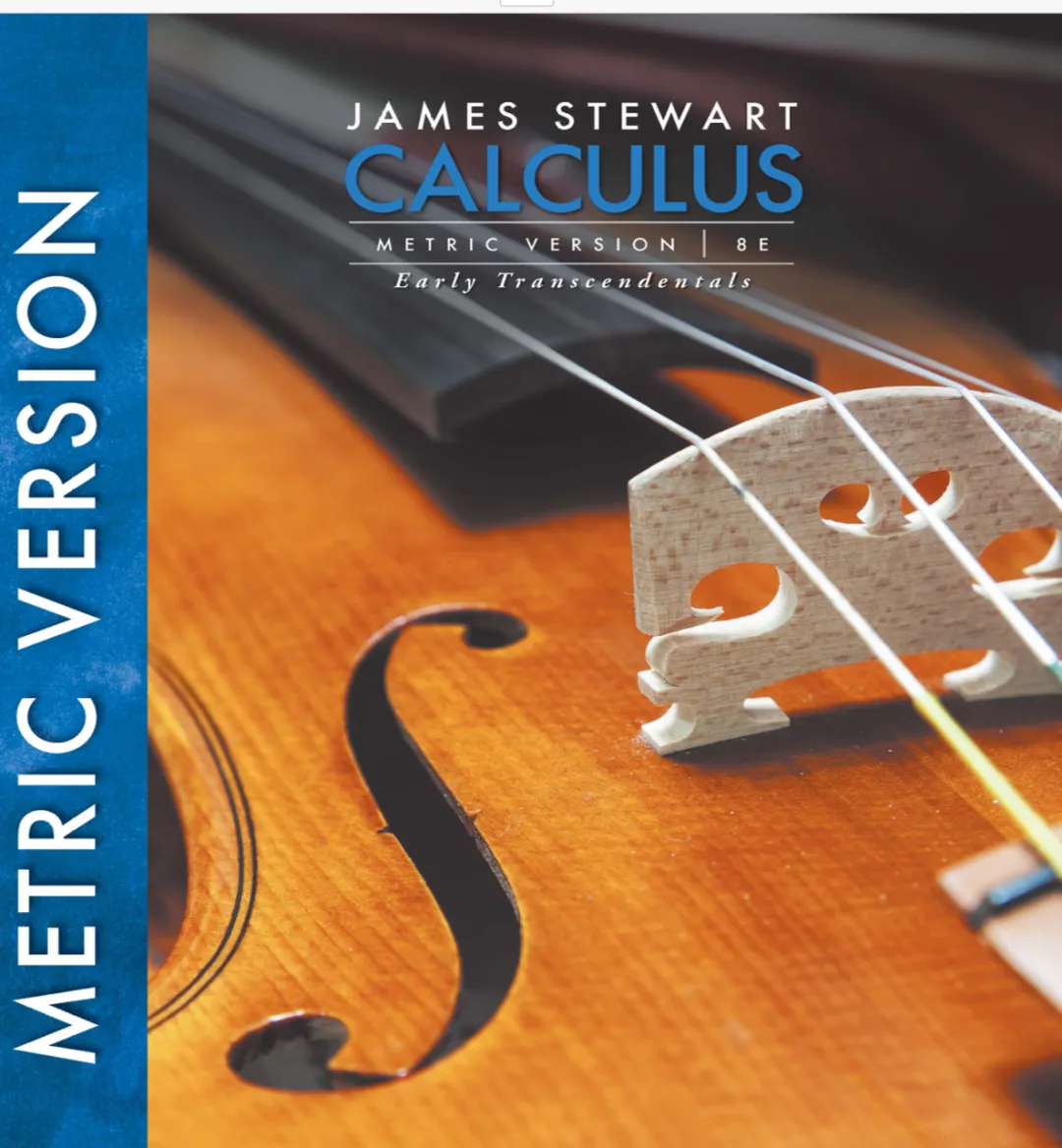
The first edition of this book was published in 1989 under the title Calculus: A First Course, initially released only in Canada. It quickly gained popularity among students, prompting the author to release a second edition with substantial additions and rename it Calculus, distributing it globally.
Calculus is arguably one of the most popular calculus textbooks in English worldwide. It has been translated into multiple languages, including Chinese (available on certain e-commerce platforms—secondhand copies on Xianyu are recommended, as due to specific reasons, some secondhand editions are in better condition than new ones). However, the Chinese version is abridged; therefore, it is advisable to study directly from the English edition. The latest English edition was published in 2020, while the Chinese edition is still based on the 2016 version.
The book begins with single-variable calculus, covering topics such as functions, limits, derivatives, integrals, and transcendental functions. It provides in-depth discussions on integration techniques, differential equations, polar coordinates, infinite sequences, and Taylor series. It then extends to multivariable calculus, including three-dimensional space and vectors, partial derivatives, multiple integrals, and vector calculus. This makes it especially suitable as a first calculus textbook for students outside of mathematics majors.
Among educators, the book is highly regarded for its rigorous, clear content and ease of student comprehension. Prior to its publication, most calculus textbooks focused solely on theory. James Stewart enhanced this textbook with graphical representations corresponding to formulas, more real-world applications (covering physics, engineering, economics, and other disciplines involving calculus), and exercises—making calculus more accessible and engaging for students.